| Home |
| Taking Responsibility |
| Global Warming |
| Local Food |
| Grow Your Own |
| About Start Now and Glenn & Jean |
| Contact Us |
|
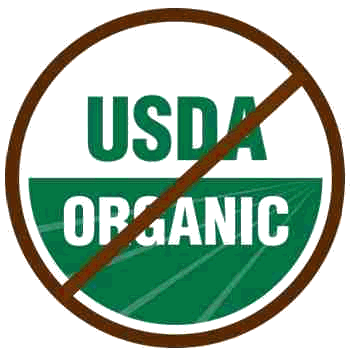
How Does Our Garden Grow? Maybe you’re surprised, because who cares more than we do about creating healthy, pesticide free gardens growing in harmony with natural systems, building fertile, friable soil, and nurturing a sustainable and sustaining environment than Start Now? If that isn’t Organic, then what is? Sadly, the truth is that "Organic" is now a word owned by the U. S. Government, ruled by standards imposed by the government, and limited by organic certification. Produce sold as "Organic" must be certified by some official agency, and that is a costly process, cost prohibitive for small growers such as Start Now. The organic movement was created by growers deeply respectful of natural systems involving living soil, constantly improved by gardening practices which yield wholesome, nutritious and tasty food, and concerned for the health of the overall environment in which food is produced. As
the movement grew and attracted consumers, who valued the quality of
organic food, the Organic label became
Only the actions of the Organic Consumers Association and some others, successfully soliciting a huge wave of public support, prevented compromises which would have gutted the entire meaning of what “organic” once stood for. Even that was not enough to prevent such travesties as Organic eggs laid by chickens who live out their lives in wire cages and Organic milk which is “ultra-pasteurized” rendering it so denatured and inert that selling it from refrigerated coolers is mere cosmetic nicety. It could be packaged in boxes and sold from the grocery shelf like “juice box” drinks. Now stores are filling with name brand Organic products such as Rice Crispies, Newman’s Own products, and Muir Glen canned vegetables from General Mills. Unfortunately, these huge food corporations are able to grow produce under existing Organic standards which perpetuates monoculture at the expense of natural habitat, degrade the soil by the use of heavy equipment and use mass produced “organic” soluble fertilizer instead of chemicals, but replace none of the nutrients they withdraw in their crops and continue to add to fertilizer runoff problems. This kind of Organic growing dictates limiting crops to those which ship well and have a long shelf life, and these Organic food systems make full use of energy consuming storage, packaging, refrigeration, shipping, warehousing, and mass marketing, delivering a product which may be as poor quality and nutrient drained as the non-Organic foods they replace, but at a higher cost to consumers and higher profit to producers. The high cost of Organic certification tends to keep small growers out of the Organic market, thus limiting competition for the food giants moving so rapidly into the field of Organic sales. The growth of the Organic share is often reported on the business pages. Organic certification has some importance for purchasers of foodstuffs from distant farms. There is some great value, after all, in knowing that the food we eat is free from pesticide residues, and Organic certification provides that assurance, as long as you trust the growers after the inspectors have left. Instead, Start Now produce is sold by the growers, who will explain their growing practices to buyers, from gardens which the buyers may see for themselves. |
Let's Call It Start Now growers avoid pesticides and follow gardening practices based on a deeply held belief system, including love for the earth and a healthy environment as well as wholesome delicious food, and therefore don’t need an external set of rules or certification inspection. The term “organic” still has a lower case meaning, which is “of the earth.” It means no chemical fertilizers and pesticides, but it also means composting and crop rotation and polyculture and reduced mechanization, and habitat enhancement, and soil and water conservation. In honor of that meaning of the word, Start Now is dedicated to following organic methods. We gardened that way long before the Organic standards were published, and will continue to do so as long as we are able to garden.
There are many farms and gardens, in our county and elsewhere, growing
for the market, that are certified Organic. Start Now gardens themselves
are grown according to Organic rules. Those rules allow for, but do not
guarantee, wholesome gardens in harmony with nature. We hail the local
Certified Organic farms and gardens, many of which are linked on the
Start Now website, operated by growers with the true spirit of organic
in their souls and a firm dedication to a local food supply. |
 more
and more attractive to corporate farmers, who saw it as a golden
opportunity to reap higher profits. Development of organic standards
occurred over a decade or more, during which there was a struggle
between the believers in organic in its most holistic sense and those
with the profit motive uppermost. It should be no surprise that the
government agency supervising the process was swayed more and more
toward the corporate interests, cost cutting, loosening of standards,
and compromise of all the environmental aspects involved. See,
more
and more attractive to corporate farmers, who saw it as a golden
opportunity to reap higher profits. Development of organic standards
occurred over a decade or more, during which there was a struggle
between the believers in organic in its most holistic sense and those
with the profit motive uppermost. It should be no surprise that the
government agency supervising the process was swayed more and more
toward the corporate interests, cost cutting, loosening of standards,
and compromise of all the environmental aspects involved. See,